Monday, February 19, 2018

Oracle 18c is on the cloud now

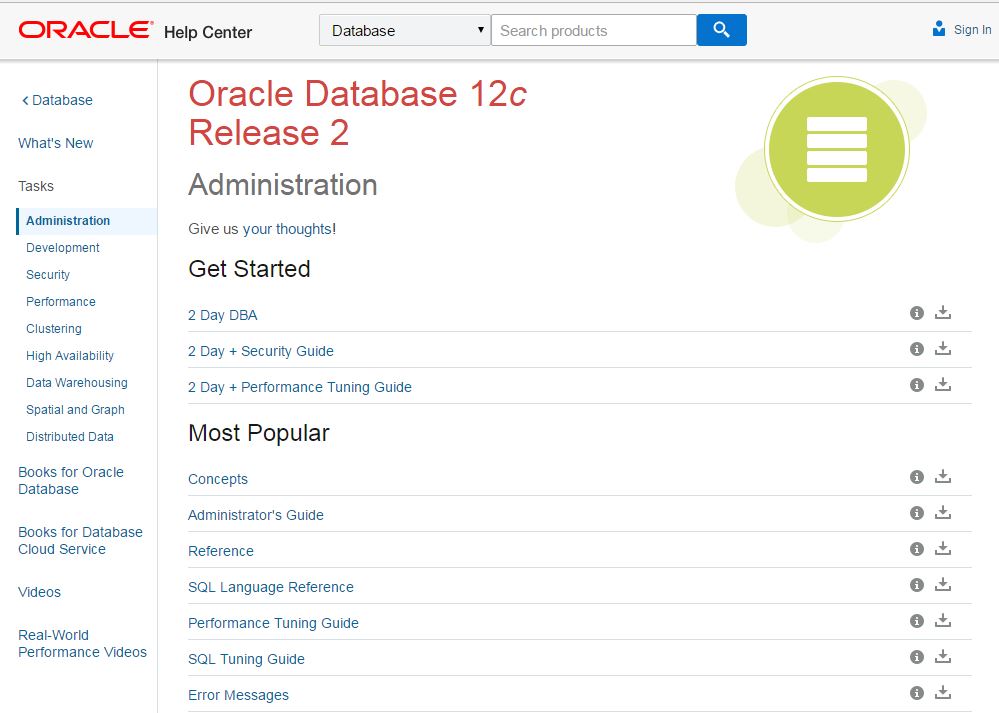
After Valentine Day, Oracle officially released Oracle Database 18c on the Oracle Cloud and Oracle Engineered Systems on Feb.16. If you still follow the old Oracle release pattern, Oracle 18c is equivalent to Oracle 12c Release 2 (12.2.0.2).

To get to know more about this release, besides reading Oracle official blog above, you can digest the following blogs from several Oracle gurus.
If you want to know the new features of this release, you can take a look at the following guide:

https://docs.oracle.com/en/database/oracle/oracle-database/18/newft/new-features.html

Since this new release is not available for on-premise environment yet, you can try it with LiveSQL even you don't have Oracle Cloud account:

https://livesql.oracle.com/apex/livesql/file/index.html

Tuesday, January 23, 2018

Oracle 18c is coming soon

Yesterday (Jan.22, 2018) the email alert from Oracle subjected on "Oracle Support HOT Topics" had an item "Release Schedule of Current Database Releases" with last updated date on Jan 19, 2018.

When I accessed the link, it directed to the Metalink Note:742060.1.  Under the section "What's New?", you will see the following information:
  • 19-Jan-2018 - added release 18 to the table
So for every release schedule table, a column for Oracle release 18 is added. From the schedule, we can get:

  • Oracle 18c for Oracle Public Cloud Releases will be available at 1Q2018 (means some time within the 1st quarter of 2018). And the same release time is applied to On-Premises Engineered Systems including Oracle Database Appliance and Exadata.
  • Oracle 18c for On-Premises Server (including client) will be available on H2CY2018 (means some time within second 6 months of 2018) for Linux x86-64, Solaris 64-bit (SPARC and x86), HP-UX Itanium, Windows 64-bit and IBM AIX/Linux platforms.

To help user plan ahead, Oracle also provides a roadmap of patch sets for Oracle Database major release 11.1 and beyond, "showing planned release dates and the duration of their support lives in relationship to the overall release life. The chart is by nature somewhat simplified so be sure to read the details below it to help you interpret it correctly."

The chart has been updated with Oracle 18c(was 12.2.0.2) and 19c(was 12.2.0.3).


Friday, October 06, 2017

Self-driving Oracle coming, so where will be the driver (DBA)?

Did you attend Oracle OpenWorld this year and listen to the keynote speech from Larry? If no, did you watch the following recorded keynote video?


Yes. It was all about Oracle Autonomous Database, the World's #1 Self-Driving Database. Certainly, Larry didn't forget to poke Amazon (AWS).

Not long ago, Oracle has changed its release schedule/name, so Oracle 12.2.0.2 becomes Oracle 18c.


Now it becomes clear, Oracle 18c is actually the foundation of  Oracle Autonomous Database service. As Oracle describes, "Powered by Oracle Database 18c, the next generation of the industry-leading database, Oracle Autonomous Database Cloud offers total automation based on machine learning and eliminates human labor, human error, and manual tuning."

Regarding the role change of Oracle DBA, there has never been one straight answer. With the recent announcement of self-driving database from Larry, the debate has been getting intense. So where will be driver? In other words, the Oracle DBA will totally disappear?


Less time on boring shit. More time on important shit!
This is firmly targeted at removing the need for operational DBAs. A role that *you* should have already automated out of your organisation anyway. If you’ve not, then you have failed.
It should be obvious that the Development DBAs are sitting pretty here. The thinkers are safe. The recipe followers are not. Your mantra from now on should be…
Keep learning. Keep improving yourself. Keep your job!
"
As I expected, very few people seem to have actually listened to what was said in the keynote and I suspect many didn’t even read the entirety of my blog post. Instead, they saw “Autonomous Database” and launched into “it’ll never work” mode. It’s like people want it to fail and want to keep doing the same old boring crap for the rest of their lives. I am hopeful this suite of services will be the start of something interesting, but time will tell. Fingers crossed!"
Larry did provide his ideas on the "Database Professionals:  Evolution of Skill Set" in his keynote speech.


Another blog echoed the same reaction about the "Death of the Oracle DBA". 
The DBA role has changed. Indeed, if your Oracle DBAs are still spending significant time on things such as space and tablespace management then it’s time to look at how your Oracle DBA support is delivered! But for all the activities that have diminished or evaporated over the past 20 years new tasks and challenges have appeared. 
What do you think?

Thursday, August 17, 2017

Oracle Database Cloud 'How To' Webcast Series - YouTube Videos


Following is a link for a very good YouTube how to video on Oracle Cloud:


It includes following videos:

  • Choosing the Right Oracle Database Cloud Service


  • Oracle Database Cloud Service Deployment Choices


  • Oracle RAC on Oracle Database Cloud Services


  • Oracle RAC on Oracle Database Cloud Bare Metal Services


  • Oracle Database Cloud Services Security (Part 1)


  • Oracle Database Cloud Services Security (Part 2)


  • Service Management using the Cloud Console


  • Enterprise Manager Cloud Control


  • Application and Database Migration to Oracle Cloud


  • Database Creation from Cloud Backup


  • Oracle Database Backup Service Overview


  • Pluggable Databases on Oracle Cloud


  • Multitenant Application Containers


Friday, August 11, 2017

Don't wait for 12.2.0.2 anymore, but Oracle 18

According the latest Oracle note - Release Schedule of Current Database Releases (Doc ID 742060.1), Oracle has changed its release schedule/name since 12.2.0.2.

It means:

Oracle 12.2.0.2 = Oracle 18
Oracle 12.2.0.3 = Oracle 19

But it does say  "This may change in the future to Oracle 20 as the last release for 12.2. "

You can read 2 blogs from Mike about the change:


Friday, August 04, 2017

DBCA fails to create 12.1.0.2 RAC database over 12.2 GI/ASM

When creating 12.1.0.2 RAC CDB on newly created 12.2.0.1 GI/ASM by using DBCA, the database creation failed with errors ORA-19504/.ORA-17502

By checking Oracle metalink, it is an Oracle bug (#21626377)  - RDBMS instance fails to identify the required disks to mount a disk group if compatible.asm of the diskgroup is higher than version of the software.

You can refer to the metalink note (Doc ID 21626377.8) for details. There are 2 ways to fix the issue:

1. Apply the BP 12.1.0.2.170418 (or later BPs) - 12.1.0.2.170718 (Jul 2017) Database Patch Set Update (DB PSU) - on Oracle 12.1.0.2 RDBMS home, so DBCA can create 12.1.0.2 database using the ASM diskgroup with compatible.asm set to 12.2.
2. Workaround 
- Create an ASM diskgroup with compatible.asm set to 12.1 and then try to create the 12.1 database.

Tuesday, May 23, 2017

Oracle 12.2 New Features Training Summary


From May 15 to 19, I took the training course - Oracle Database 12c R2: New Features for 12c R1 Administrators Ed 1 (5 days) at ExitCertified Toronto. The instructor was Eric Wong.

By considering that Oracle Database 12c Release 2 was only available outside the Cloud in March, this training was quite new. Except those early players on the cloud, inside Oracle or “hired” by Oracle, there was really not many people to use or test this new release.  

This 5-day course was really intensive. As described in the course outline, I was expected to learn the following knowledge:


Different from the Oracle training course I took before, this one focused more on practice (>=70%). The instructor really didn’t talk too much about any topics. Some of topics only had less than 5 slides.  I spent most of my 5 days to practice, precisely speaking, cut and pasted the commands from the PDF guide. So it is not hard for you to imagine how “intensive” the training was.

When you spent most of time to catch up the practice, there was really not much time and energy for you to digest the “New Features”. It will leave to us either reviewing the course materials again after training or recalling it when using the new features in our work. No matter which option, we need to spend more time to get familiar with those new features before we totally forget.

To briefly summarize what I learned in the training, I would like to draw several high-level points below:
  • From database container (CDB) to application container – Oracle will make the database software more robust and agile to support application development.
  • Make PDB as isolate/independent as possible (from CDB) in terms of resource management, performance management, availability (backup/recovery), portability, etc.
  • Make database and related product more cloud-ready including security enhancement, monitoring (Grid Control), etc.
  • Continue to enhance the security features including auditing, privilege control, data redaction, encryption, etc.
  • Continue to enhance the performance improvement automation such as Optimizer Statistics Advisor.
  • Continue to enhance the database availability and online operations including PDB hot clone, online redefinition, online DDL capabilities and partitioning.
  • Continue to enhance the management tools including DB operations monitoring, SQL*Plus, SQLcl, ADR automatic space file management, etc.
There are something not covered in the training, but discussed or blogged by the SIG:
  • Oracle Database 12c R2 Rapid Home Provisioning and Maintenance:
  • Oracle 12c Grid Infrastructure Management Repository (GIMR)
       http://www.oracleracsig.org/events/oracle-12c-grid-infrastructure-management-repository-gimr-everything-you-wanted-to-know-2/

All in all, the best training materials for the new release are still the reference books from Oracle. Among them, it is the bible - Oracle Database Concepts, 12c Release 2 (12.2).

Wednesday, November 16, 2016

Oracle Database 12.2 available now on Oracle Cloud

At the beginning of this month (November), Oracle Database 12c Release 2 (12.2.0.1) was finally available through DBassS on the Oracle Cloud after its first offering as Exadata Express Service in September. Oracle also released 12.2 documentation


The ORACLE-BASE Blog from Tim Hall also provided a bit more detail about this new release. You can also check Marco Gralike's blog to get first impression of  Oracle 12.2.0.1 on the cloud.


Monday, October 10, 2016

Oracle Database 12.2 New Features

As I said in my previous blog, at OOW2016 Oracle made clear statement -  "the latest release Oracle 12.2 was officially announced to be first made available in the cloud. " The first available platform is Exadata Express Cloud Service.With this service, the customer can get Oracle Database 12c Release 2 Enterprise Edition plus options running on Exadata in Oracle Cloud.

If you have neither joined Oracle 12.2 beta program nor used Exadata Express Cloud Service, you can at least learn about Oracle 12.2.

Here are some publicly available documents from Oracle:

Database 12.2 New Features Guide https://docs.oracle.com/cloud/latest/exadataexpress-cloud/CSDBF/toc.htm

Using Oracle Database Exadata Express Cloud Servicehttps://docs.oracle.com/cloud/latest/exadataexpress-cloud/CSDBP/toc.htm

Monday, September 19, 2016

Oracle 12.2 available on cloud first

“Amazon’s lead is over. Amazon is going to have serious competition going forward. And we’re very proud of our second generation of Infrastructure as a Service. We’re going to be focusing on it and aggressively featuring it not only during Oracle OpenWorld but for the remainder of this fiscal year and next fiscal year and the year after that.” said Oracle Executive Chairman and CTO Larry Ellison in his opening keynote presentation at Oracle OpenWorld 2016.
  
What about Oracle’s new second-generation datacenters? According to Larry, it will offer twice as many cores as Amazon, twice as much memory as Amazon, 4 times as much storage as Amazon, and more than 10 times the I/O capacity of Amazon. Not only that, in order to get your order, Larry also promised you will pay less (than that paid to Amazon).

Is Oracle still a database company? Yes. It still sells its Oracle databases including Oracle Database 12c Release 2, aka, Oracle 12.2. But this time, Larry told the audience, “You will see as we develop features for the cloud, we’ll also start delivering our software in the cloud first. Clearly it’s going to go on-premises, but the first deployment of our database and a lot of our software now is going to go to the cloud first.”No surprise, the latest release Oracle 12.2 was officially announced to be first made available in the cloud. By checking Oracle website, there is no schedule yet for the on-premises version.

As I mentioned in my another article, Oracle has been working hard to convince customers to move to the cloud. Under current strategy, it makes sense for Oracle to attract more customers especially new ones into its cloud service. With its new push into IaaS market against Amazon, Oracle will need more applications and software running on its powerful and cheap infrastructure including its own latest software like Oracle 12c database. By doing this, Oracle will not only demonstrate the new software’s features and functions, but also fully test and fix its new software before shipping its on-premises version.

If your company has used Oracle Exadata machine, you know Oracle had developed “secret sauce” (software function) just for its own hardware to gain more performance. We can then expect Oracle to run its own software much better on its own cloud infrastructure than on other cloud platforms like Amazon.

However, the majority of Oracle’s revenue still came from its non-cloud business. Unlike Amazon, who generated its cloud business revenue from zero (without any legacy non-cloud IT services), Oracle might experience some sort of pain when cloud service eating some of its existing business.

No choice. Amazon is there, so is Microsoft. Larry knows he has to win in the cloud. “Oracle competes at all three levels of the cloud, all three tiers of the cloud.” he said in his keynote speech.

Sunday, May 29, 2016

Oracle runs to Cloud, where will DBA go? (3)

If you are an Oracle DBA (at least Oracle DBA in a typical company with IT department), can you think of your responsibilities?

You can easily Google the term "typical Oracle DBA works" and will get tons of results. I just pick up one from the top search result. From its "Oracle DBA Responsibilities" list, you will find lots of works done by Oracle DBA is to "create", "maintain", "install", "backup", "support" Oracle databases. I will also add "configure", "patch", "upgrade", etc.

Another chart below can also demonstrate the current "Top DBA Challenges" although the survey was a little bit old.


So, in the coming cloud era, what will be changed for the role of DBA? As said in "Cloud Considerations for DBAs", cloud "can alleviate the need for the administrator to install, configure, and provision the database. This enables the database to scale as needed." In other words, Oracle DBA will work less on the administration of Oracle database, at least the typical works of Oracle DBA.

Does it mean the companies will not need any Oracle DBAs if they build Oracle on the cloud?

About 5 years ago, Oracle Guru Julian Dontcheff already wrote an article - The role of the DBA in the Private Database Cloud.  His point is "The cloud will bring more challenges and need for DBA work to the enterprise."

Another recent article - Key Challenges Facing the Modern Database Administrator from Gerardo Dada, Vice President, Database Product Marketing and Strategy, SolarWinds gave more clear answers to the above question: "the cloud, DevOps, and other shifts in technology are making the entire IT department more application-focused. In the end, applications are what matters to the business and to end users. This means DBAs are being held accountable for application performance, not only database performance."

In the end, what will you do as an Oracle DBA in the cloud era? Oracle has some answers for you too.

When moving to the Oracle Cloud, Oracle DBA will need to understand:
  • The overall architecture of the Oracle Database Cloud,
  • How to migrate to the cloud,
  • How to create an instance,
  • How to configure connections,
  • How to back up and recover databases in the cloud,
  • How to use Cloud DBA tools.
For sure, the above list is not enough. As an Oracle DBA, your goal is to deliver better application performance (yes, application performance). So you will:
  • Be proactive and align behind end-user experience as a shared objective across the entire IT organization by looking at application performance and the impact that the database has on it continuously, not only when it becomes a major problem.
  • Measure performance based not on an infrastructure resources perspective, but on end-user wait times. Wait-time analysis gives DBAs a view into what end-users are waiting for and what the database is waiting for, providing clear visibility into bottlenecks.
  • Keep the stability of databases just as other infrastructure teams or cloud providers striving on stabilizing their networks, hardware, software, etc.
Oracle runs to Cloud, where will DBA go? DevDBA. I replace the "Ops" to DBA in the popular word "DevOps". 

Sunday, May 15, 2016

Oracle runs to Cloud, where will DBA go? (2)

As an Oracle DBA, you might think why Oracle cares so much about "CLOUD". For years, Oracle has been the No.1 RDBMS in the market.

RankDBMSDatabase ModelScore
May
2016
Apr
2016
May
2015
May
2016
Apr
2016
May
2015
1.1.1.OracleRelational DBMS1462.02-5.51+19.93
2.2.2.MySQL Relational DBMS1371.83+1.72+77.56
3.3.3.Microsoft SQL ServerRelational DBMS1142.82+7.77+11.79
4.4.4.MongoDB Document store320.22+7.78+42.90
5.5.5.PostgreSQLRelational DBMS307.61+3.89+34.09
6.6.6.DB2Relational DBMS185.96+1.87-15.09
7. 8. 8.Cassandra Wide column store134.50+4.83+27.95
8. 7. 7.Microsoft AccessRelational DBMS131.58-0.39-14.00
9.9. 10.Redis Key-value store108.24-3.00+13.51
10.10. 9.SQLiteRelational DBMS107.26-0.70+2.10

Source: DB-Engines Ranking (as of May 2016)


Source: Gartner (October 2015)

However, when you scrutinize the latest company financial report (March 15, 2016), you will know why Oracle worries about its existing database business and cares more about "CLOUD".
  • Cloud software as a service (SaaS) and platform as a service (PaaS) revenues were$583 million, up 57% in U.S. dollars and up 61% in constant currency. 
  • Cloud infrastructure as a service (IaaS) revenues were $152 million, down 2% in U.S. dollars and up 2% in constant currency. 
  • Total Cloud Revenues were $735 million, up 40% in U.S. dollars and up 44% in constant currency. 
  • Total On-Premise Software Revenues were $6.3 billion, down 4% in U.S. dollars and unchanged in constant currency. 
  • Total Hardware Revenues were $1.1 billion, down 13% in U.S. dollars and down 8% in constant currency. 
  • Total Services Revenues were $793 million, down 7% in U.S. dollars and down 2% in constant currency.
According the report from Fortune, "as for Oracle’s third quarter, sales of new software licenses for products that run on-premises fell 11% year over year. That on-premises category makes up 70% of Oracle’s overall revenue, so there’s reason for concern there." 

Also, when you check the above Gartner Magic Quadrant figure, you will find out Gartner placed Microsoft ahead of Oracle within the LEADERS's quadrant. It is not because of the market share of RDBMS, but the result of Microsoft's recent investments in its data platform, including Azure DocumentDB, the managed NoSQL database in the cloud. Microsoft SQL Server is also popular not only on-premises but in the cloud. In May, Microsoft also announced the SQL Server will soon be available on Linux.

On the other front,  Amazon which is considered as the absolute leader of cloud computing also grabs huge database market share and is surprisingly in the LEADERS's quadrant just below Oracle. As we all know, AWS offers Amazon RDS and Amazon DynamoDB. Last year, Amazon also launched its own database engine called Aurora as a new database service on the AWS cloud.

We don't even mention the competition from IBM (DB2) and SAP (SAP HANA) as well as other vendors like Teradata and tons of open source or NoSQL databases (MongoDB, Cassandra, CouchDB, etc.).

Oracle might still have years to collect money from its traditional RDBMS product and service, but Larry has to fight in the CLOUD. It matters.